The advertised per-seat price is not the price. Here is the arithmetic — every government rate sourced to a published document, and the one Houston detail almost nobody gets right.
Every provider quotes a per-seat number. Almost none of them quote what lands on the invoice. The gap is not a rounding error and it is not a surprise to the people selling — it is the predictable sum of a federal assessment, two Texas ones, a county fee, a state surcharge, sales tax, and whatever the provider decides to call its own recovery charge.
Below is the whole stack for a Houston business, with a source for each figure. Nothing here is our estimate of what a provider charges. It is what the government publishes, applied to a per-seat price.
The Federal Universal Service Fund is funded by a contribution factor the FCC sets every quarter. For the third quarter of 2026 that factor is 38.8% — a record high — published in FCC DA 26-546.
That figure is not applied to your whole bill. It applies to the interstate portion, and rather than measure it, most VoIP providers use the FCC’s 64.9% safe harbor from FCC 06-94 ¶32. Multiply the two and the effective load on a business VoIP seat is 25.18%.
For context, the same federal mechanism lands on a mobile phone at roughly 13%. Business VoIP carries close to double, because the safe harbor treats far more of the service as interstate.
The Texas Universal Service Fund assessment sits on top of the federal one, at 12% of intrastate charges, effective 1 July 2023. It is worth knowing that this rate moves: it was 24% until the Public Utility Commission halved it in May 2023.
Note the words intrastate charges. Providers decide what share of your service counts as intrastate, and they do not publish that number. It is one of the two questions worth asking before you sign — more on the second below.
The Harris County 9-1-1 service fee is $1.40 per business line, per month, per the Greater Harris County 9-1-1 FY2026 budget. Most of Texas pays the $0.50 state rate. On top of that sits the Texas 9-1-1 equalization surcharge at $0.06 per line per month.
Those are flat per-line amounts, which means their weight depends entirely on your per-seat price. On a $50 seat they are noise. On a $10 seat they are 14.6% before anything else has been added.
Houston’s sales tax rate is 8.25%, and nearly every cost guide applies that figure to telecom. It is wrong, and the reason is genuinely obscure.
Under Texas law telecommunications services are subject to the 6.25% state sales tax but are exempt from local sales tax unless a jurisdiction has specifically voted to impose it. The Comptroller keeps the list in Publication 96-339. The City of Houston voted to impose it, effective 10/01/1987. The Metropolitan Transit Authority of Harris County did not — only seven Texas transit authorities appear on that list, and Houston’s is not one of them.
So the ceiling on telecom sales tax in Houston is 7.25%, not 8.25%. The missing point is METRO.
There is a second wrinkle in the same direction. Publication 94-132 says local sales tax may not be imposed on interstate long-distance charges at all. Where a provider separately states those, the local 1% comes off that portion — which means the same intrastate question that moves your TUSF line also moves your sales tax. Two line items, one answer, and it is an answer your provider has and you do not.
Almost every quote you receive will be missing this, and almost every invoice will have it. It travels under several names — Regulatory Recovery Fee, Regulatory Cost Recovery, Compliance and Administrative Cost Recovery — and it is charged per seat, per month, on top of the taxes.
Providers set the amount themselves. Several state plainly in their own published fee disclosures that it is not a tax and is not mandated by any government agency. Some charge materially more than the government charges they are nominally recovering. Ask for it as a dollar figure before you sign, not as a line on your first invoice.

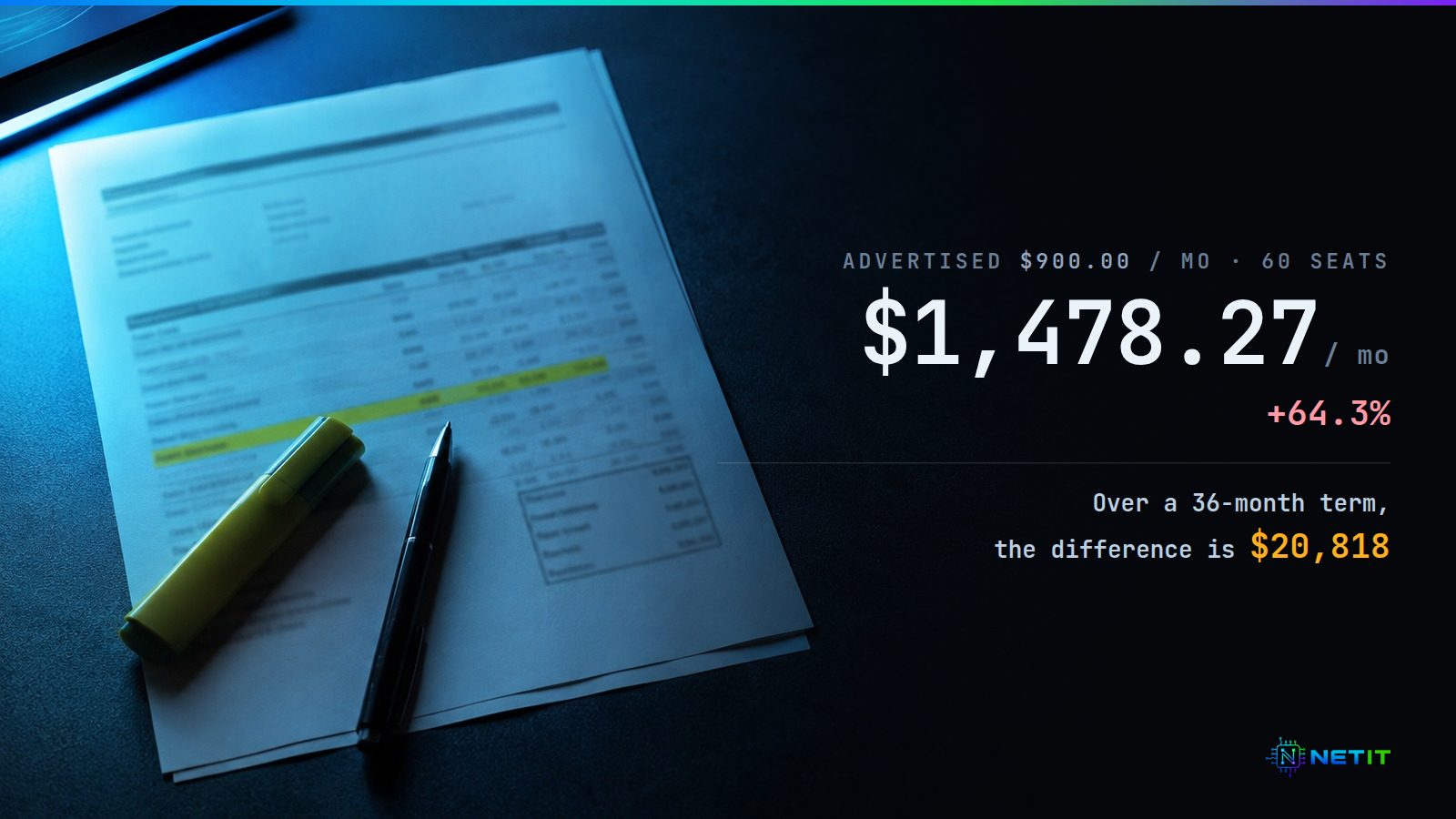
Take a 60-seat Houston business quoted at the published $15.00 annual-billing rate. That is $900.00 a month advertised.
Government charges alone — federal USF at 25.18%, TUSF, the Harris County fee, the state equalization surcharge and Texas sales tax — bring it to $1,317.39 a month. That is +46.4%, and not one dollar of it is the provider’s.
Add a $2.50 per-seat recovery fee, which is well inside the ordinary range, and the actual monthly figure is $1,478.27. That is +64.3% on the advertised price.
Business phone contracts are commonly written on 36-month terms. Over that term, the difference between the quoted price and the real one is $20,818 — on the same quote, from the same provider. The number simply was not on the page.
Everything above is recurring. The one-time costs of moving are a separate conversation, and they are almost never in the quote:
Implementation, professional services or onboarding. Number porting — per number, and whether the carrier you are leaving charges to release them. Handsets and headsets, or the decision to go softphone-only. Network readiness: PoE switch capacity, bandwidth, QoS or SD-WAN. E911 dispatchable-location setup for every site and every remote user, which is not optional — Kari’s Law and the RAY BAUM’S Act require direct 911 dialling with no prefix, on-site notification, and a dispatchable location down to the floor and room. Training and go-live support. And the one nobody budgets: your current system’s bill running in parallel through cutover.

Ask these before you sign, and get the answers in writing:
1. What is the term, and does the advertised rate assume 36 months? 2. Does it auto-renew, and how many days’ notice must you give to stop it? 3. If you leave early, what exactly is the formula? Published agreements in this category range from a stated early-termination fee with no amount attached, to the full remaining term plus taxes. 4. What is the rate after the promotional period ends? 5. Is there a minimum seat commitment, and what happens if you shrink?
A word on what this is and is not. Every government rate above is published and linked. The intrastate share used to weight TUSF and local sales tax is a modelled assumption, because providers do not publish theirs — which is exactly why it is on the ask-list rather than presented as fact. Your invoice will differ. This is the floor, not the total.
Rates change. The federal USF factor resets every quarter. Figures here are current as of 26 August 2026.